Extended Info:
Purchase at your own pace without missing out on multiple purchase discounts. Discounts are applied retrospectively, so as you reach each purchase milestone—4, 8, 12, 20, and 40 feeders – all of your current and previous purchases are discounted at the same level.
Note: Discount program amounts include all grain and hay feeder purchases. Creep panels, creep gates, roofs, and other accessories or attachments are not included.
Extended Info:
Purchase at your own pace without missing out on multiple purchase discounts. Discounts are applied retrospectively, so as you reach each purchase milestone—4, 8, 12, 20, and 40 feeders – all of your current and previous purchases are discounted at the same level.
Note: Discount program amounts include all grain and hay feeder purchases. Creep panels, creep gates, roofs, and other accessories or attachments are not included.
Extended Info:
Purchase at your own pace without missing out on multiple purchase discounts. Discounts are applied retrospectively, so as you reach each purchase milestone—4, 8, 12, 20, and 40 feeders – all of your current and previous purchases are discounted at the same level.
Note: Discount program amounts include all grain and hay feeder purchases. Creep panels, creep gates, roofs, and other accessories or attachments are not included.
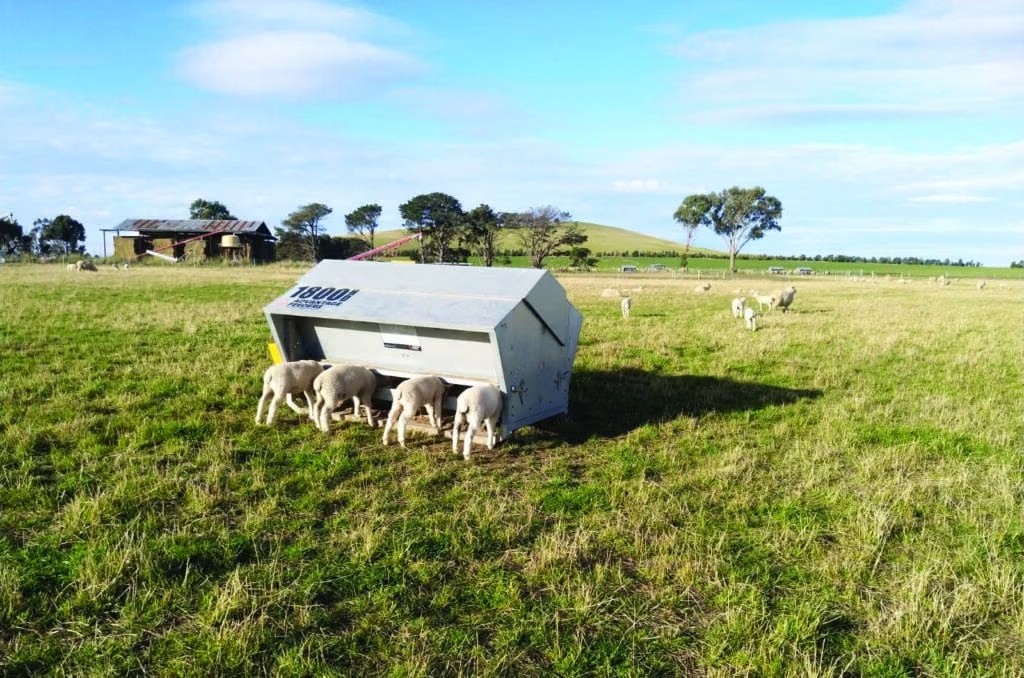
Butyric acid is made from high starch feeds and is vital for rumen development. When deciding whether and what to creep feed, farmers find themselves asking:
1. Which type of feed will result in the highest growth rates?
2. Does the percentage of starch in a feed lead to higher growth rates?
3. Which feed type will be most profitable based on a range of lamb prices?
4. Which feed type will be most profitable based on a range of feed prices?
5. Which type of feed flows best and requires the least feeder maintenance?
The objective of the experiment is to provide insight to these questions.
www.teagasc.ie/animals/beef/calf-rearing/#rumen.
| Breed *** | Terminal Breed | Feed Type |
| Composite | Composite | Reid Stockfeeds cracked grain mix |
| Composite | Composite | Ridley cracked grain mix |
| Composite | Composite | Ridley lamb pellet & whole wheat (50:50) |
| Composite | Composite | Control group – no additional supplement |
| Merino x Composite | Composite | Whole wheat |
| Merino x Composite | Composite | Cracked wheat |
| Merino x Composite | Composite | Cracked wheat & high protein pellet (80:20)**** |
| Merino x Composite | Composite | Control group – no additional supplement |
*Every effort was made to ensure the feed on offer was the same for each group however, some slight variations may have existed between the groups.
**Feed consumption monitored every 7 days. When average daily intake reached 200g per lamb per day, feeders were adjusted to limit intake to meet target ration.
***The feed results of groups that have different maternal breeds needs to be acknowledged when making comparisons.
****High protein pellet contains 30% protein.
For the first 21 days of the experiment, all feed groups had an intake close to 50g per lamb per day. Consumption rose from this to approximately 200g per lamb per day in the following 14 days. This demonstrates how quickly lambs adapt to a ration change and highlights the need to measure feed intake on a regular basis. Failure to do this may result in profit erosion due to excessive consumption.
Feeders containing cracked grain mixes and high protein pellets required weekly cleaning to ensure consistent feed flow. The flow of the other feeders was considerably better, as a result fewer cleaning visits were needed.
At the commencement of the experiment each group had the same number of twins and triplets however, the numbers of lambs per ewe varied. The groups that had the higher survival rate received less milk per lamb and this likely led to lower growth rates. This variable makes the net profit per ewe an important metric to analyse.
Ideally, this experiment would be conducted with a single type of maternal ewe. However the large scale of this experiment resulted in us supplying two different types of maternal ewes. The results of groups that have different maternal breeds needs to be acknowledged when making comparisons. Eg. It would be hard to directly compare the "Whole Wheat" group against the "Ridley Cracked Grain Mix" because they had different breeds of ewes in the groups.
At the completion of the experiment, the Upper and Lower Adjusters were required to be set to position 3 to limit consumption in the wheat group to approximately 200g per lamb per day. This was more restricted than any other group. Despite this, the average consumption over the 76 days was the highest at 286g per lamb per day. With the Advantage Feeders used, further restriction was possible but was not implemented in this case.
Close inspection of the dung from the two groups fed a ration containing whole wheat was examined. It was difficult to find undigested grains indicating little grain was passed from the rumen before microbial activity accessed starch in the kernel.
| Group | Cracked Wheat | Whole Wheat | Reid Cracked Grain Mix | Ridley Cracked Grain Mix | Ridley Pellets & Whole Wheat (50:50) | Cracked Wheat & High Protein Pellet* (80:20) |
| Starch content** | 75% | 75% | 43% | 43% | 60% | 60% |
| Protein content** | 14% | 14% | 18% | 18% | 15% | 18% |
| % of grains cracked | 100% | 0% | 100% | 100% | 40% | 100% |
| Cost of feed per tonne delivered | $350 | $320 | $550 | $465 | $390 | $390 |
| Avg. daily intake over 76 days (g/lamb/day) | 197 | 286 | 152 | 173 | 220 | 216 |
| Avg. cost of feed per lamb | $5.24 | $6.95 | $6.36 | $6.11 | $6.52 | $6.39 |
| Avg. daily weight gain over control group (g/day) | 55 | 55 | 59 | 44 | 56 | – |
| Feed conversion*** | 3.6 : 1 | 6.0 : 1 | 2.6 : 1 | 3.9 : 1 | 3.9 : 1 | – |
| Avg. gain in value over control group @$4.00/KgLW | $16.82 | $16.61 | $17.82 | $13.40 | $16.88 | – |
| Net profit per lamb**** | $11.58 | $9.66 | $11.46 | $7.22 | $10.36 | – |
| Lambs per ewe in each group***** | 1.55 | 1.69 | 1.53 | 1.72 | 1.70 | – |
| Lambs per ewe above control group | -0.22 | -0.08 | -0.08 | 0.11 | 0.09 | |
| Net profit per ewe | $17.91 | $16.37 | $17.58 | $12.58 | $17.59 | – |
| Maternal breed | Merino x Composite | Merino x Composite | Composite | Composite | Composite | Merino x Composite |
| Terminal breed | Composite | Composite | Composite | Composite | Composite | Composite |
* The high protein pellets became mouldy as a result of wet and humid weather. The lambs became ill and their growth was affected.
** Percentage is the component of the feed rations dry matter.
*** Feed conversion: Kilograms fed to achieve 1kg of liveweight gain.
**** Note: This does not include filling, monitoring or depreciation costs.
***** Average lambs per ewe in the Composite control group was 1.61. Average lambs per ewe in the Merino x Composite group was 1.77.
Changes based on a variation to the lamb price ($AUD)
Table 1.1
| Group | Cracked Wheat | Whole Wheat | Reid Cracked Grain Mix | Ridley Cracked Grain Mix | Ridley Pellets & Whole Wheat (50:50) |
| Net profit/lamb @$3.00/kgLW | $7.37 | $5.51 | $7.00 | $3.94 | $6.14 |
| Net profit/lamb @$3.50/kgLW | $9.48 | $7.59 | $9.23 | $5.62 | $8.25 |
| Net profit/lamb @$4.00/kgLW | $11.58 | $9.66 | $11.46 | $7.29 | $10.36 |
| Net profit/lamb @$4.50/kgLW | $13.68 | $11.74 | $13.68 | $8.97 | $12.47 |
| Net profit/lamb @$5.00/kgLW | $15.78 | $13.82 | $15.91 | $10.64 | $14.58 |
Changes based on a variation to the lamb price ($AUD)
Table 1.1
| Group | Cracked Wheat | Whole Wheat | Reid Cracked Grain Mix | Ridley Cracked Grain Mix | Ridley Pellets & Whole Wheat (50:50) |
| Cost of feed per tonne delivered | $400 | $370 | $600 | $515 | $440 |
| Net profit/lamb @$4.00/kgLW | $10.83 | $8.58 | $10.88 | $6.64 | $9.52 |
| Cost of feed per tonne delivered | $350 | $320 | $550 | $465 | $390 |
| Net profit/lamb @$4.00/kgLW | $11.58 | $9.66 | $11.46 | $7.22 | $10.36 |
| Cost of feed per tonne delivered | $300 | $270 | $500 | $415 | $340 |
| Net profit/lamb @$4.00/kgLW | $12.33 | $10.75 | $12.04 | $7.95 | $11.19 |
| Cost of feed per tonne delivered | $250 | $220 | $450 | $365 | $290 |
| Net profit/lamb @$4.00/kgLW | $13.07 | $11.84 | $12.61 | $8.61 | $12.03 |
Due to the number of variables encountered during this experiment, the most significant being lamb survival rates (Table 1.0), means that no definitive conclusion can be made regarding the best feed for creep feeding. A future experiment that measures growth rates and identifies the litter size of the lamb would better indicate the performance of each feed.
The high protein pellets in this experiment were not proportion of grains need to be cracked to achieve suitable for creep feeding
In addition to the issue with the feed flow, the high protein pellets that were mixed with cracked wheat had two more issues. The lambs sorted the ration and left the high protein pellets in the trough. Additionally, and of more consequence, was that the pellets were affected by the wet and humid weather. The pellets went mouldy and caused the lambs to become ill, affecting their growth rates. The composition of this pellet was not suited to the environment of creep feeding.
The amount of starch in all feeds was adequate
There is no link between the amount of starch in each group and additional weight gain.
Making the starch more available by cracking or pelletising led to better feed conversions
The feed conversion ratio for the group fed whole grain was 5.2:1. Comparing this with the conversion ratios achieved by the other four feeds in this experiment suggests that cracking grain has a positive influence on digestibility. For example, the Ridley pellets and whole wheat ration (40% of its total grain content was cracked) achieved a conversion rate of 4.0:1 indicating that only a low feed conversion ration. Repeated trials are needed to confirm this finding.
The amount of protein contained in the feeds used in this experiment varied (Table 1.0). The lambs in each group received protein from their mother's milk and the pastures they grazed. As a result, there does not appear to be a link between the amount of protein in the feeds tested and the additional growth rates recorded.
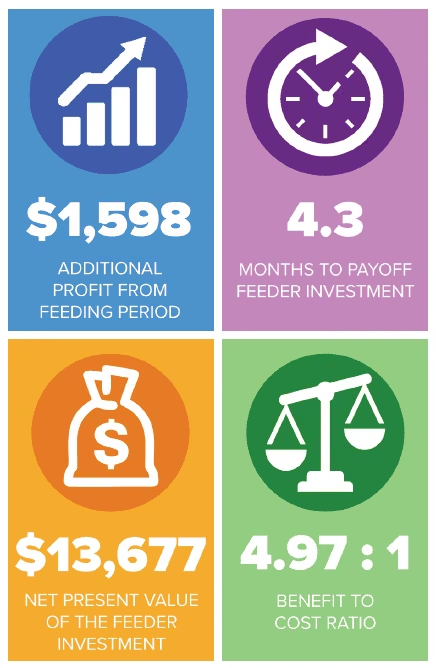
The experiment does not conclude which feed type is the most profitable however it does show that all creep fed groups grew considerably faster than the control groups and were more profitable. Using the values observed during the experiment and calculating the possible profit from feeding a commercial quantity of 200 lambs, a return of $1597.85 is possible for a feeding period of only 76 days. This return would see an Advantage Feeders 1800HD with creep panels paid off in as little as 4.3 months.
Table 1.1 shows how a variation in lamb prices impacts the overall profit of each different creep feed ration. Based on feed prices remaining the same and the lambs per feeder increasing to 200, the break-even point is when lamb is $2.02/kgLW.
Table 1.2 shows how a variation in feed prices impacts the overall profit of each different creep feed ration. With lamb valued at $4.00/kgLW, increasing and decreasing the feed price by $50/ tonne, decreases and increases the profitability, on average of the five groups, by $0.78/lamb. The feed prices in this experiment were affected by drought conditions in eastern Australia. It is possible feed prices will fall in the future and the application of creep feeding will be more profitable than the results indicate here.
In the experiment we found that a feed with a starch content of 43% of dry matter (Table 1.0) is adequate to achieve high growth rates in creep fed lambs. Barley commonly has a starch content of approximately 65% making it suitable for creep feeding. Many factors go into choosing a feed however, on price alone, barley can be cheaper per unit of starch than wheat, making it an attractive option.
Each farm will have its own unique circumstances to consider, including size, infrastructure, non- livestock farming, labour availability and intensity. A creep feed ration that is more profitable for one farm may be different to another farm.
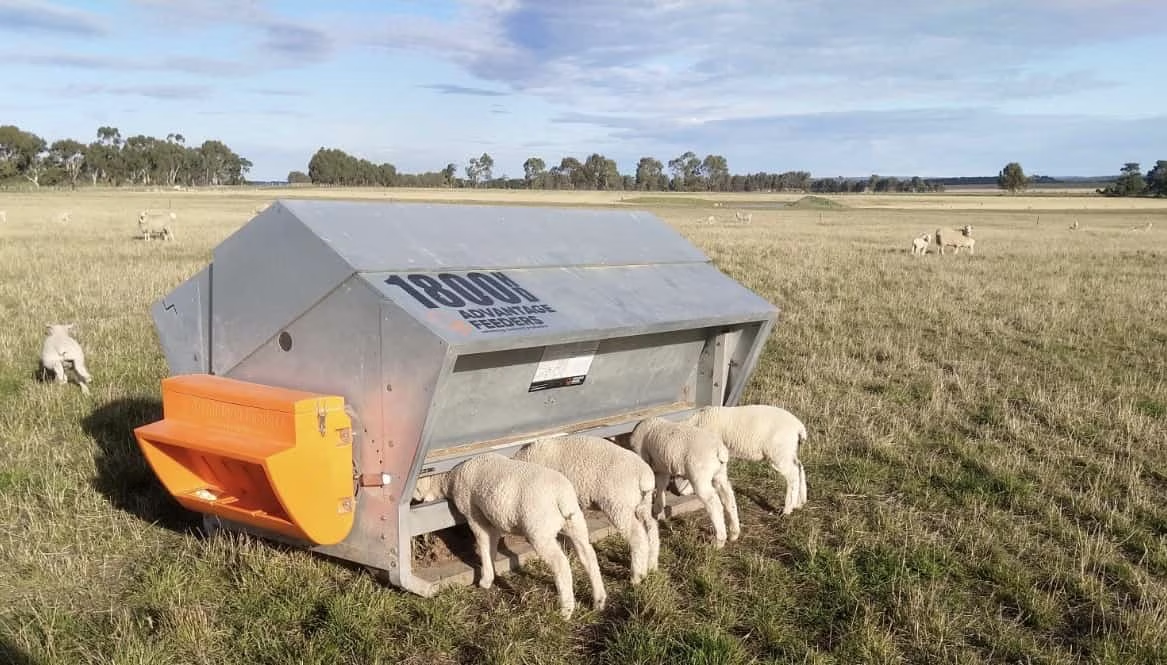
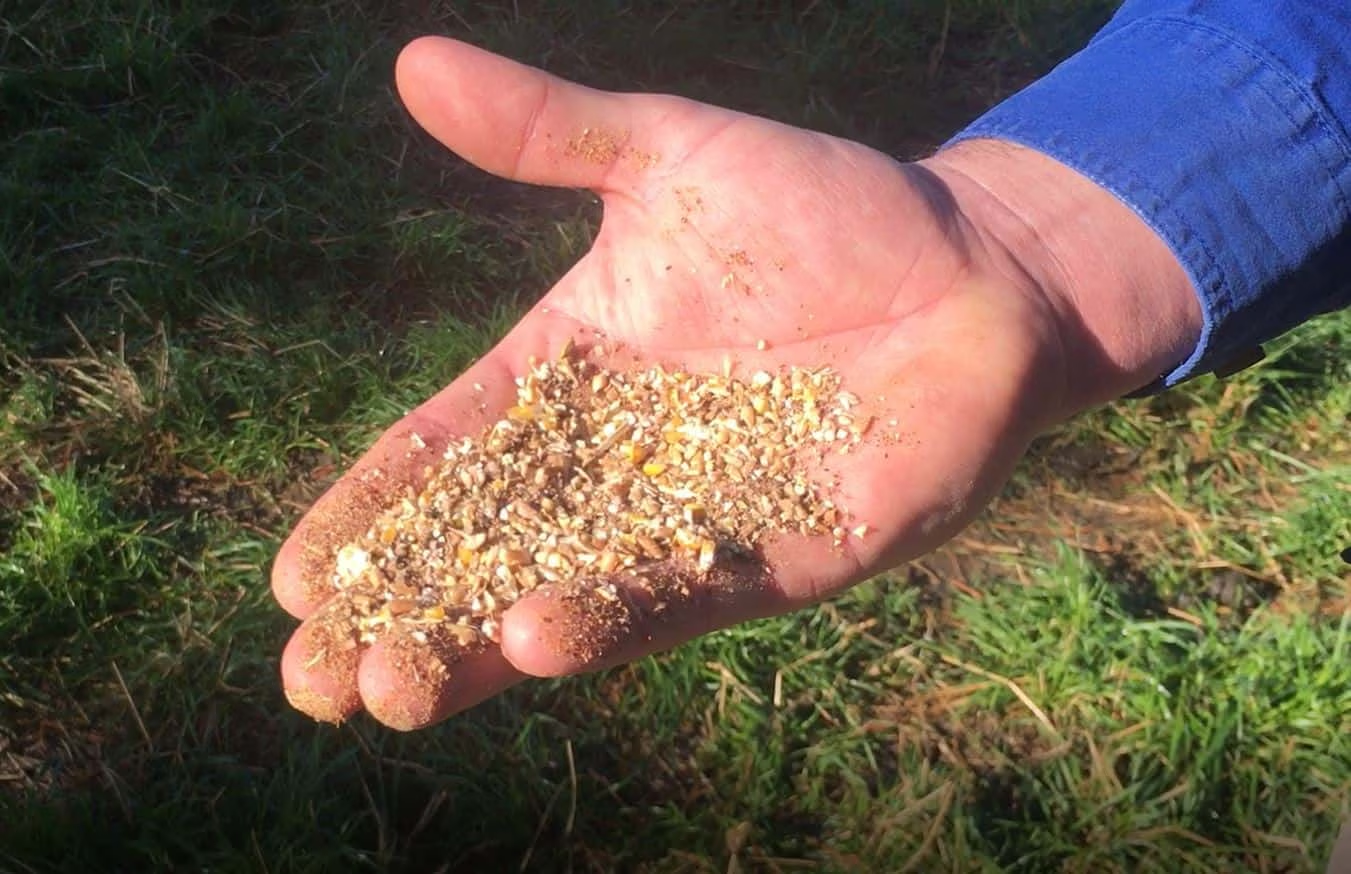
We conduct on-farm trials to test and demonstrate the effectiveness of our products. Each trial provides practical, evidence-based insights that guide our work and support informed decision-making.
Advantage Feeders was developed in Australia and is now used by livestock farmers in the UK and around the world.
Advantage Feeders are distributed throughout the UK by Wise Agriculture Ltd, a family-run agricultural equipment business based in North Yorkshire.
Our range includes controlled grain and pellet feeders for sheep, cattle, deer and goats, along with creep-feeding and hay-feeding solutions designed to help farmers improve feed efficiency and livestock performance.
Advancing Ruminant Production
Help livestock farmers double meat production with the same level of inputs
Through continual research and development, we strive to provide livestock farmers with the world’s best controlled feeding products, knowledge and systems that allow them to achieve the highest return on investment